


Metabolic Adaptation: Why Your Weight Loss Stalled and What to Do Next explains why metabolic adaptation can make eating less produce smaller results over time.
You may be following the same diet, exercising harder, and wondering why the scale suddenly stopped responding. Many people assume the answer is another calorie cut.
That approach can miss what is happening beneath the surface. Muscle, daily movement, hunger, sleep, hormones, and recovery can all change during weight loss.
At Eternal Vitality in Orlando, Florida, we view a weight-loss plateau as information. The goal is understanding what changed before simply restricting more.
Table of Contents
What Is Metabolic Adaptation, and Why Can It Cause a Weight-Loss Plateau?
Metabolic adaptation describes changes in energy expenditure that can occur during prolonged calorie restriction and weight loss. Your body becomes more efficient with available energy.
Some slowing is expected because a smaller body requires fewer calories. Adaptive thermogenesis describes additional reductions beyond those predicted by body-size changes.
A 2022 systematic review examined 33 studies involving 2,528 adults. Researchers identified adaptive thermogenesis in 27 studies, although its size varied considerably.
Importantly, stronger studies often found smaller effects. Metabolic adaptation is real, but it does not mean your metabolism suddenly becomes permanently damaged.
Your Metabolism Becomes More Energy Efficient
Think of your body like a household facing a smaller monthly budget. When income decreases, spending becomes more careful.
Your body can respond similarly during prolonged energy restriction. Resting metabolic rate may fall, while spontaneous movement can quietly decrease.
Hunger may also increase as the body responds to weight loss. Meanwhile, fatigue can make training and everyday movement harder to maintain.
This is why metabolic adaptation should be viewed as a group of changes, not one broken metabolic switch.
One of the most important changes involves body composition. Weight loss can include both body fat and lean tissue.
A 2025 review of 25 randomized trials found resistance training helped protect fat-free mass during dietary weight loss. It also improved strength.
Muscle does not burn enormous amounts of calories at rest. Its value goes far beyond simply raising your basal metabolic rate.
Muscle supports strength, glucose handling, training capacity, physical function, and healthier body composition.
The scale measures weight. Your metabolism responds to what that weight is made of.
Eternal Vitality Takeaway: Successful weight loss should protect metabolic capacity, not simply produce the lowest possible number on a scale.
Can Metabolic Adaptation Become Harder to Manage When You Keep Eating Less?
A common pattern begins with successful calorie restriction. Weight decreases, confidence increases, and the original strategy appears to work well.
Then progress slows. Many people respond by cutting food again while adding more cardio.
Hunger rises, strength training suffers, and recovery becomes harder. Daily movement may also decrease because the person is simply more tired.
The result can be a smaller energy deficit than expected, despite feeling like much more effort is being applied.
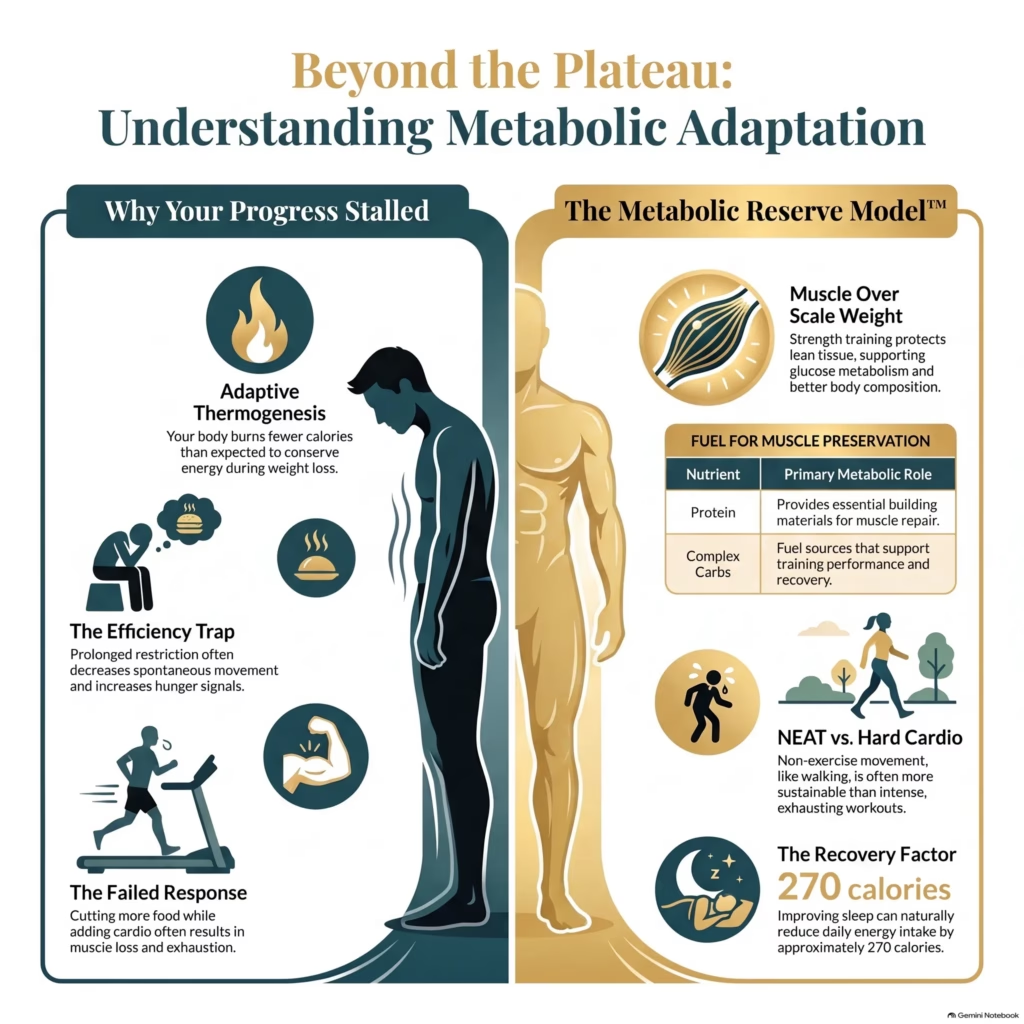
Muscle Preservation Changes the Weight-Loss Equation
At Eternal Vitality, we explain this using the Metabolic Reserve Model™.
Metabolic reserve is not a medical diagnosis. It is a simple framework for understanding the resources that support sustainable fat loss.
Five factors matter:
- Muscle: supports strength, glucose metabolism, and body composition.
- Movement: includes exercise and non-exercise activity thermogenesis, or NEAT.
- Fuel: provides protein, fiber, carbohydrates, and nutrients needed for function.
- Recovery: includes adequate sleep and appropriate rest from training.
- Hormonal environment: influences appetite, energy, muscle, recovery, and body composition.
Aggressive dieting can weaken several areas at once.
Many patients believe protein is the only nutritional requirement for building muscle. They may remove almost every carbohydrate from their diet.
Protein provides amino acids needed for muscle repair. However, resistance training creates the stimulus that tells the body to maintain muscle.
Appropriate complex carbohydrates can support glycogen stores, training performance, and recovery. Options include potatoes, oats, beans, fruit, quinoa, and whole grains.
Carbohydrates do not automatically prevent fat loss. They also do not create fat loss by themselves.
Protein provides building material. Carbohydrates can help provide the fuel needed to use it.
NEAT is another frequently overlooked part of the equation. It includes walking, standing, household tasks, errands, and other everyday movement.
Someone may exercise hard for 45 minutes, then sit most of the day because the workout left them exhausted.
That person increased planned exercise but may have unknowingly reduced total daily movement.
More cardio can also increase hunger in some people. This can make an already restrictive nutrition plan difficult to sustain.
What Should You Do When Metabolic Adaptation Has Stalled Your Weight Loss?
A plateau should create curiosity before it creates another calorie reduction.
Start by asking what changed. Are your steps lower, workouts weaker, meals irregular, sleep shorter, or hunger much stronger?
Also consider hydration, fiber, food quality, stress physiology, hormone balance, gut health, and recovery. These systems influence one another.
The better strategy may involve improving metabolic conditions rather than simply demanding more from an increasingly tired body.
A Clinical Perspective: Protecting Metabolic Reserve Comes First
A common scenario in our clinical experience begins with one question: “Why am I gaining weight while eating less?”
The patient may already be eating less than when weight loss started. Cardio has increased, but strength and daily steps have declined.
We often find other opportunities as well. Water intake may be low, fiber may be inadequate, sleep may be poor, and empty calories remain.
Instead of automatically cutting food again, we may first prioritize walking, hydration, fiber, resistance training, and better food quality.
Some patients also benefit from more consistent meals. Skipping meals can sometimes create severe hunger later and make nutrition harder to sustain.
Eating more frequently does not magically increase metabolism. Meal frequency is an adherence tool, not a metabolic hack.
Sleep deserves the same attention. In a randomized trial of 80 adults sleeping less than 6.5 hours, researchers tested sleep extension.
Participants who increased sleep reduced daily energy intake by about 270 calories compared with controls. Sleep alone does not guarantee weight loss.
The finding shows why recovery cannot be separated from appetite and metabolic health.
Hormonal health may also deserve evaluation when symptoms, medical history, or clinical findings suggest a concern.
Hormones cannot override energy balance. However, hormone balance may influence hunger, muscle preservation, sleep, recovery, energy, and fat distribution.
This whole-body approach connects Eternal Vitality’s core pillars of hormones, metabolism, sleep, stress, gut health, nutrition, and body composition.
You cannot consistently outwork a nutrition and recovery lifestyle that does not support your physiology.
A plateau is not always a signal to eat less. Sometimes it is a signal to protect more.
Metabolic Adaptation: Why Your Weight Loss Stalled and What to Do Next Conclusion & Next Step
Metabolic adaptation may help explain why the weight-loss strategy that worked initially becomes less effective later.
Your metabolism may not be broken. Your body may simply be adapting through changes in energy expenditure, hunger, movement, muscle, and recovery.
Protecting muscle, increasing NEAT, improving hydration, eating adequate fiber, using appropriate complex carbohydrates, and prioritizing sleep may improve the overall strategy.
For patients in Orlando, evaluating metabolism alongside hormonal health and body composition can provide a clearer picture than focusing on calories alone.
This article is educational and does not diagnose or replace individualized medical care. Needs, responses, and appropriate strategies vary between individuals.
Book a Vitality Discovery Session to explore how your metabolism, hormones, nutrition, body composition, and lifestyle work together.
Frequently Asked Questions
Is metabolic adaptation the same as a broken metabolism?
No. Metabolic adaptation is a normal biological response that may occur during weight loss.
Its magnitude varies considerably, and it does not mean your metabolism has permanently stopped functioning.
Why am I gaining weight while eating less?
Short-term weight changes can reflect water, digestion, hormones, medication, sodium, carbohydrates, and other factors.
Longer plateaus may also involve changing energy needs, reduced movement, muscle loss, or inconsistent intake.
Should I cut calories again when weight loss stops?
Not automatically. First review your steps, muscle preservation, training performance, sleep, hydration, fiber, hunger, and current food intake.
A small adjustment may eventually be appropriate, but deeper restriction should not be the automatic response.
Do carbohydrates make metabolic adaptation worse?
Carbohydrates do not inherently cause metabolic adaptation.
Appropriate complex carbohydrates may support training, muscle glycogen, and recovery while fitting within a well-designed fat-loss plan.
Can walking really help when harder exercise has stopped working?
Walking increases NEAT without creating the recovery demands of another intense workout.
For many people, increasing sustainable daily movement may be more practical than continually adding cardio.
Eternal Vitality
4361 Hunters Park Ln
Orlando, FL 32837
(407) 710-1840