


Normal testosterone but still have symptoms? This is one of the most common and frustrating situations I see in men who come to Eternal Vitality looking for answers. They’re tired all the time, their sex drive has declined, and they’re noticing changes in their strength, motivation, and overall sense of well-being. Some have been dealing with these problems for years.
When I ask about their previous testosterone testing, I frequently hear the same response: “My doctor checked my testosterone and said everything was normal.”
The problem is that a normal total testosterone level doesn’t necessarily tell us how much testosterone is actually available for your body to use. And when someone is experiencing persistent symptoms, that distinction can be important.
At Eternal Vitality in Orlando, Florida, I believe hormone evaluation should involve more than looking at a laboratory report. The numbers matter, but so does understanding how you’re feeling and what else might be affecting your health.
TL;DR: What You Need to Know
If your testosterone levels are normal but you’re still experiencing fatigue, low libido, erectile dysfunction, or decreased strength, there may be more to investigate.
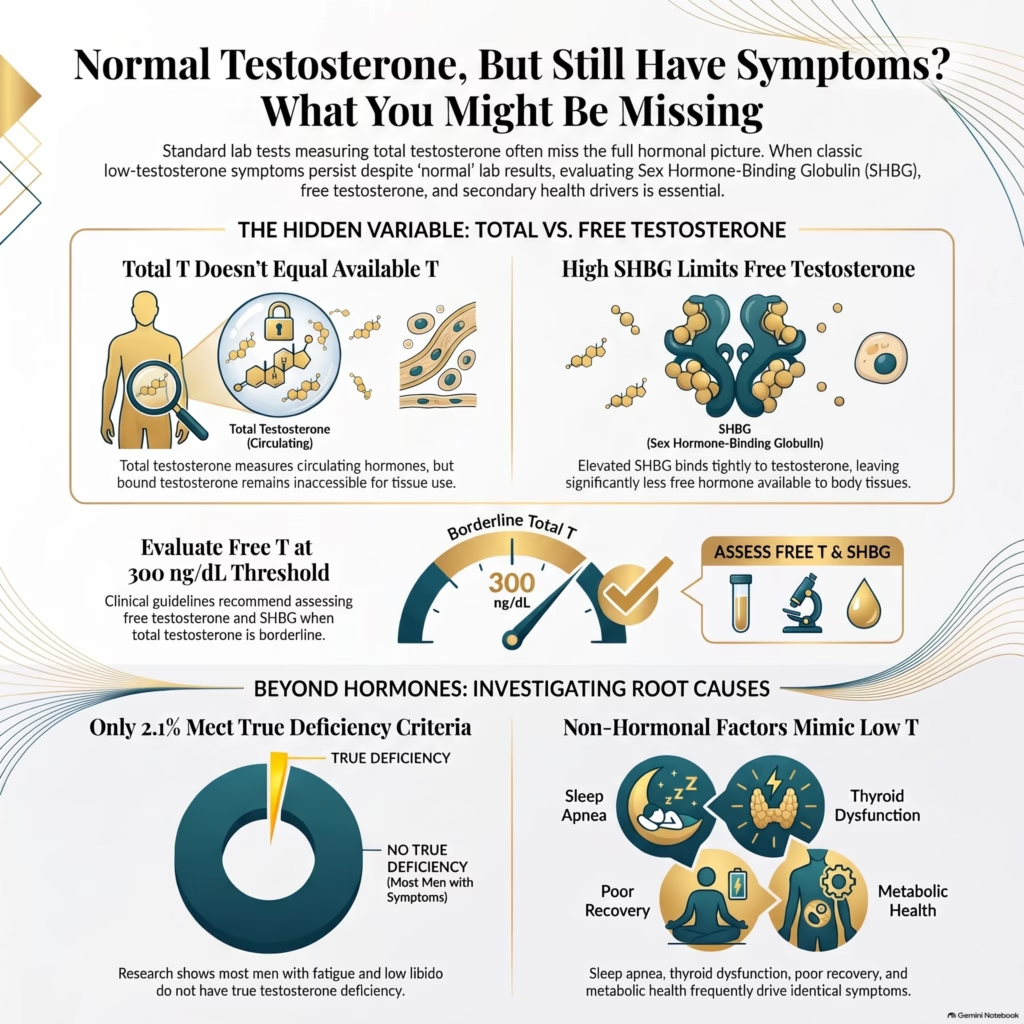
Total testosterone measures the testosterone circulating in your bloodstream, but much of it is attached to proteins. One of those proteins, called sex hormone-binding globulin (SHBG), influences how much testosterone remains freely available to your body.
This is why evaluating free testosterone and SHBG can sometimes reveal information that total testosterone alone misses.
However, testosterone isn’t the only factor affecting how you feel. Sleep, thyroid function, metabolic health, medications, and other medical conditions can produce similar symptoms. The goal isn’t simply to raise testosterone levels. It’s to understand why you’re experiencing symptoms and determine what treatment, if any, is appropriate.
Table of Contents
Normal Testosterone but Still Have Symptoms and Still Feel Terrible?
When most men have their testosterone checked, the initial test measures total testosterone. This is an important starting point, but it doesn’t always give us the complete picture.
Testosterone travels through your bloodstream in different forms. Some is tightly attached to a protein called SHBG, another portion is loosely attached to albumin, and a small percentage circulates freely. These differences influence how readily testosterone is available to your tissues.
I often explain this by comparing testosterone to money in a bank account. Imagine having $10,000 in your account, but most of it is locked away and unavailable to spend. Your balance might look good, but the amount you can actually access is much smaller.
Something similar can happen with testosterone. A man might have a total testosterone level of 500 ng/dL, but if his SHBG is elevated, his free testosterone could be considerably lower than expected.
Understanding How SHBG Influences Available Testosterone
SHBG is produced primarily by the liver and helps transport sex hormones through the bloodstream. It’s a normal part of hormone regulation, but its concentration can vary significantly between individuals.
Aging, thyroid function, liver health, certain medications, and nutritional factors can all influence SHBG. For example, an overactive thyroid can increase SHBG, while obesity and insulin resistance are frequently associated with lower concentrations.
When SHBG is elevated, a greater proportion of circulating testosterone may be tightly bound. This can leave less testosterone freely available, even when the total testosterone result appears acceptable.
This is why I pay attention to the relationship between total testosterone and SHBG. A relatively low testosterone-to-SHBG ratio can raise concern about reduced hormone availability and help guide further evaluation.
However, this ratio isn’t a validated substitute for free testosterone testing or an established predictor of treatment response. When appropriate, free testosterone can be measured using specialized laboratory methods or calculated from total testosterone, SHBG, and albumin.
The Endocrine Society recommends evaluating free testosterone when total testosterone is borderline or SHBG may be abnormal.
Your total testosterone level tells us what’s circulating. It doesn’t always tell us what’s readily available.
What Can Testosterone Levels and SHBG Reveal When Symptoms Don’t Match Your Labs?
I remember a 42-year-old man who came to see me after being told his testosterone was normal. He had been struggling with fatigue, decreased mood, low libido, erectile dysfunction, and declining strength and endurance.
These symptoms were affecting multiple areas of his life, yet his previous evaluation hadn’t provided an explanation.
When I reviewed his laboratory results, his total testosterone was 300 ng/dL, and his SHBG was 65 nmol/L.
A testosterone level of 300 ng/dL is near the threshold that warrants additional evaluation. However, what particularly caught my attention was his elevated SHBG. This raised concern that his free testosterone could be substantially lower than his total testosterone suggested.
After further evaluation, we started testosterone treatment. Over time, he reported improvements in his energy, mood, libido, erectile function, strength, and endurance.
His experience doesn’t mean everyone with a testosterone level of 300 needs treatment. It demonstrates why symptoms and laboratory findings need to be considered together.
A Complete Hormone Evaluation Looks Beyond Reference Ranges
One thing I want patients to understand is that a laboratory reference range isn’t the same as a complete assessment of hormonal health.
The American Urological Association identifies 300 ng/dL as a reasonable threshold supporting the evaluation of testosterone deficiency. However, diagnosis requires compatible symptoms and repeat early-morning testing.
Research also demonstrates why symptoms matter. In a study involving 3,369 men, researchers found that decreased morning erections, low sexual desire, and erectile dysfunction were particularly associated with low testosterone.
Interestingly, the study found that only about 2.1% of the men with complete relevant data met its criteria for late-onset hypogonadism. This reminds us that common symptoms don’t always indicate testosterone deficiency.
The research reinforces something I frequently discuss with patients: fatigue, low motivation, and declining physical performance deserve attention, but they aren’t specific to testosterone deficiency.
The most useful evaluation combines your medical history, symptoms, physical examination, and appropriate laboratory testing rather than relying on one result.
How Should Testosterone Levels Guide Treatment Without Overlooking Your Overall Health?
One mistake I frequently encounter is focusing so heavily on testosterone numbers that we lose sight of the patient.
Sometimes a man is dismissed because his total testosterone falls within the reference range. Other times, testosterone doses are increased because symptoms persist, without investigating why treatment hasn’t produced the expected improvement.
Neither approach adequately addresses the entire picture.
Testosterone doesn’t function independently from the rest of your body. Sleep quality, thyroid function, metabolism, nutrition, body composition, and recovery all influence how you feel.
For example, a man receiving testosterone therapy may have adequate hormone levels but continue experiencing fatigue because he has untreated sleep apnea. Another may struggle with strength and recovery because of inadequate nutrition, thyroid dysfunction, or metabolic problems.
Increasing testosterone in these situations may not address the underlying issue and could introduce unnecessary risks.
Meaningful Improvement Requires More Than Higher Testosterone Numbers
When I’m evaluating a patient’s response to testosterone treatment, I want to know more than whether his laboratory values increased.
Has his libido improved? Does he have more energy throughout the day? Is his mood better? Is he recovering from exercise? Does he feel more like himself?
These questions help us determine whether treatment is producing meaningful benefits.
I also use the relationship between testosterone and SHBG as one piece of additional clinical context. However, no testosterone-to-SHBG ratio establishes a validated dosing ceiling. Treatment adjustments must account for symptoms, physiological hormone levels, and safety monitoring.
The Testosterone Trials, involving 790 older men with low testosterone, found improvements in sexual activity and desire with treatment. Benefits for physical function and vitality were less consistent.
That distinction matters because testosterone therapy isn’t a universal solution for fatigue or declining performance.
A Clinical Perspective
Many men have felt poorly for so long that they’ve gradually accepted their symptoms as normal aging. They may not remember what it feels like to have consistent energy, a healthy sex drive, or good exercise recovery.
I don’t believe we should automatically dismiss these changes as inevitable. But I also don’t believe every symptom should be attributed to testosterone.
My approach is to identify whether hormone deficiency is contributing, determine what other factors might be involved, and monitor whether treatment produces meaningful improvements.
Appropriate testosterone treatment also requires discussing fertility, monitoring hematocrit, assessing relevant prostate health considerations, and reviewing other medical risks.
The goal isn’t to achieve the highest testosterone number. It’s to help the patient feel better while keeping treatment medically appropriate and safe.
This broader philosophy connects our hormone care at Eternal Vitality with metabolic health, nutrition, gut health, and recovery.
Conclusion: Understanding Testosterone Levels Is Only the Beginning
Testosterone levels provide valuable information, but they don’t tell the entire story of how your body is functioning. Total testosterone, SHBG, free testosterone, symptoms, and overall health each contribute something important to the evaluation.
If you’ve been told your testosterone is normal but you still feel exhausted, have low libido, or struggle with declining physical performance, I would encourage you to have a more detailed conversation with your physician.
Ask whether your testing was performed appropriately, whether free testosterone and SHBG should be evaluated, and whether another medical condition could be contributing to your symptoms.
At Eternal Vitality in Orlando, our goal is to understand the patient behind the numbers and develop individualized treatment plans based on clinical findings.
If you don’t feel like yourself, you deserve an evaluation that looks beyond a single laboratory result.
Book a Vitality Discovery Session to learn more about our approach.
The Eternal Vitality Takeaway
A normal total testosterone level doesn’t always mean your body has adequate available testosterone. Understanding the relationship between testosterone, SHBG, symptoms, and overall health gives us a more complete picture.
The goal isn’t simply to improve your laboratory numbers. It’s to understand why you don’t feel well and determine how to address the underlying problem appropriately.
Frequently Asked Questions About Testosterone Levels
Can I have low free testosterone even if my total testosterone is normal?
Yes. Elevated SHBG can reduce the proportion of testosterone circulating freely, even when total testosterone appears acceptable. Appropriate testing can help determine whether this difference is clinically significant.
Why would my SHBG be elevated?
SHBG can increase with aging, hyperthyroidism, certain liver conditions, medications, and nutritional changes. Elevated SHBG doesn’t automatically indicate disease, but understanding why it’s elevated may be important when interpreting testosterone results.
Is 300 ng/dL a normal testosterone level for a man in his 40s?
A testosterone level of 300 ng/dL is near the American Urological Association’s recommended diagnostic threshold. Its significance depends on symptoms, repeat morning measurements, and other clinical findings.
Why do I still feel tired even though I’m taking testosterone?
Fatigue can result from sleep disorders, thyroid conditions, metabolic problems, medications, or inadequate recovery. If testosterone levels are adequate but symptoms persist, increasing the dose may not be the appropriate solution.
Does testosterone treatment always improve libido and energy?
No. Men with confirmed testosterone deficiency may experience improvements, particularly in sexual symptoms. However, responses vary, and fatigue or reduced energy may have other causes that require separate evaluation.
Eternal Vitality
4361 Hunters Park Ln
Orlando, FL 32837
(407) 710-1840