
Why do I keep regaining weight after GLP-1 medications?
Why do I keep regaining weight after GLP-1 medications? The answer is often not what most patients expect. In many cases, weight regain happens because the focus was placed entirely on losing weight rather than learning how to maintain it.
At Eternal Vitality in Orlando, Florida, we see this misunderstanding regularly. Patients are often told how to lose weight with a GLP-1 medication. Few are taught how to keep the weight off once the medication is reduced or discontinued.
GLP-1 medications can be powerful tools. They have transformed the treatment of obesity and helped millions of people achieve meaningful weight loss. However, a tool is not a complete strategy.
The most successful patients do not simply use GLP-1 medications to lose weight. They use the weight loss phase to build the habits, knowledge, and metabolic foundation needed for long-term success.
The question is not whether the medication works.
The real question is whether the underlying reasons for weight gain were ever addressed.
Table of Contents
Why Do Most People Regain Weight After GLP-1 Medications?
One of the biggest misconceptions in modern weight management is that weight loss and weight maintenance are the same thing.
They are not.
Weight loss and weight maintenance require different skills, different strategies, and often a different mindset.
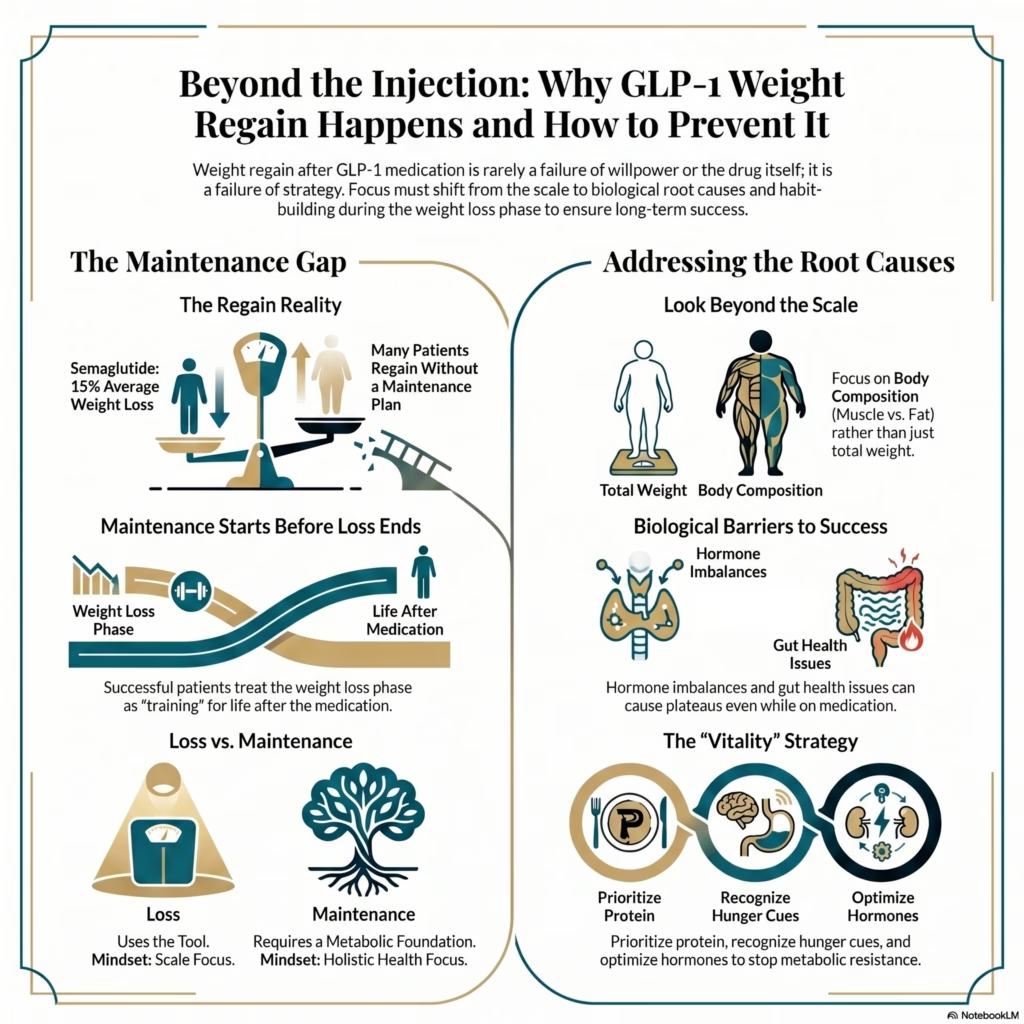
Clinical studies have shown that GLP-1 medications can help patients lose significant amounts of weight. Semaglutide studies demonstrated average weight reductions approaching 15% of total body weight in many participants.
However, follow-up studies revealed another important finding. Many participants regained a substantial portion of the weight after stopping treatment.
This does not mean the medication failed.
It means that maintenance requires its own plan.
Long-Term Success Is Built During The Weight Loss Phase
Maintenance starts before weight loss ends.
Imagine signing up for a marathon six months from now despite never running before.
Would you simply wait until race day and hope everything works out?
Of course not.
You would train. You would build endurance. You would learn proper pacing. You would gradually develop the habits needed to finish the race successfully.
Weight maintenance works exactly the same way.
GLP-1 medications create a valuable opportunity to train for life after the medication.
During treatment, patients should ideally be learning:
- How to build balanced meals
- How to prioritize protein intake
- How to recognize hunger versus cravings
- How to navigate emotional eating triggers
- How to maintain consistency when motivation fluctuates
- How to support metabolism through lifestyle habits
Many patients use GLP-1 medications to lose weight.
The most successful patients use GLP-1 medications to learn how to maintain weight.
That difference may determine whether the results last.
Why Does Weight Regain Occur Even When The Medication Is Still Working?
Many people assume weight regain only happens after stopping treatment.
In reality, that is not always true.
One of our patients, a healthy and motivated 31-year-old woman, came to us after losing approximately 50 pounds on a GLP-1 medication through another clinic.
Most people would consider that a success story.
The problem was that she had been stuck for nearly nine months.
Despite continuing the medication, eating well, and exercising consistently, her weight loss plateaued. Even more frustrating, she had started regaining weight while still taking the medication.
She assumed she needed a higher dose.
Many clinicians would have reached the same conclusion.
Instead, we asked a different question.
What if the medication was not the problem?
Root Causes Often Matter More Than Dosage
More medication is not always better.
After evaluating her health more comprehensively, we identified underlying gut health issues that appeared to be contributing to metabolic resistance.
Once those issues were addressed, her progress resumed.
She went on to lose another 30 pounds.
She reached her goal weight.
She successfully weaned off the medication.
Most importantly, she continues to maintain both her weight and body composition today.
Her story highlights one of the most important lessons in weight management.
Sometimes the issue is not that a treatment is failing.
Sometimes the treatment has uncovered a deeper problem that still needs to be addressed.
Research suggests that more than 40% of adults in the United States are affected by obesity. This statistic reminds us that weight gain is rarely caused by a single factor.
Hormones, metabolism, appetite regulation, sleep quality, stress physiology, and digestive health all play important roles.
What if your body is not resisting weight loss?
What if it is responding to an underlying issue that has never been identified?
Could Hormones And Gut Health Be The Missing Pieces Behind GLP-1 Weight Regain?
For many patients, this is where the real breakthrough occurs.
Weight gain is often treated as a calorie problem.
Many times it is far more complex.
Two of the most common root causes we encounter are hormone imbalances and gut health dysfunction.
Both can contribute to metabolic resistance and make long-term weight management significantly more difficult.
Body Composition Reveals What The Scale Cannot
Scale weight rarely tells everything.
At Eternal Vitality, we view obesity primarily as a body composition challenge rather than simply a weight problem.
The scale measures total weight.
It does not measure body fat percentage.
It does not measure lean muscle tissue.
It does not measure metabolic efficiency.
Two people can weigh exactly the same amount while having dramatically different body compositions and health profiles.
This is why body composition analysis often provides a more meaningful picture of progress.
Hormone imbalances involving thyroid function, testosterone, estrogen balance, cortisol regulation, or insulin signaling can influence metabolism, energy levels, appetite, and body composition.
Gut health may be equally important.
The digestive system influences nutrient absorption, inflammation, metabolic function, appetite regulation, and even food cravings.
When gut health is compromised, many patients experience symptoms such as:
- Bloating
- Irregular digestion
- Energy fluctuations
- Increased cravings
- Difficulty maintaining weight loss
Weight regain is often viewed as a willpower problem.
In our experience, it is frequently a physiology problem.
Addressing the underlying biology may create opportunities for lasting success that calorie restriction alone cannot achieve.
A Clinical Perspective
After helping patients with weight management, one pattern appears repeatedly.
The patients who maintain their results long term are rarely the patients with the strongest willpower.
They are the patients with the strongest strategy.
They understand that weight loss is only one phase of the journey.
They use the months spent on a GLP-1 medication to prepare for the maintenance phase that follows.
They address root causes.
They improve their nutrition.
They support sleep quality.
They optimize hormone balance when appropriate.
They improve gut health.
They focus on body composition rather than obsessing over a number on a scale.
Most importantly, they understand that the medication is often the catalyst.
The real transformation occurs when the underlying barriers to health are identified and addressed.
Conclusion & Next Step
The question is not whether GLP-1 medications work.
For many people, they absolutely do.
The better question is this:
What happens when the medication is no longer doing the work for you?
Many patients regain weight because they never learned how to maintain their results. Others stop treatment without a transition strategy. Some continue treatment for months or years without addressing the root causes that contributed to weight gain in the first place.
The most successful patients view GLP-1 medications differently.
They use the weight loss phase as training for the maintenance phase.
They train for the marathon before race day arrives.
They improve their eating habits, support their metabolism, address hormone and gut health challenges, and build a body capable of maintaining its success.
Long-term weight management is rarely about finding the perfect medication.
It is about creating the conditions that allow lasting results to occur.
Book a Vitality Discovery Session.
For individuals throughout Orlando seeking sustainable weight management, understanding the root cause may be the most important step toward achieving results that truly last.
Frequently Asked Questions
Why do people regain weight after stopping GLP-1 medications?
Weight regain may occur when appetite returns, maintenance habits have not been established, or underlying metabolic factors remain unaddressed.
Can someone regain weight while still taking a GLP-1 medication?
Yes. Some patients experience plateaus or regain weight despite remaining on treatment. This may indicate that additional factors such as hormones, gut health, sleep, or metabolism need evaluation.
Is obesity a weight problem or a body composition problem?
While weight matters, body composition often provides a more complete picture of health by evaluating body fat, lean tissue, and metabolic status.
Can hormone imbalances contribute to weight regain?
Hormonal imbalances can influence appetite, energy levels, metabolism, and body composition, which may affect long-term weight management.
Why is gut health important for weight maintenance?
Gut health can influence inflammation, nutrient absorption, metabolism, appetite signaling, and food cravings, all of which may affect weight management outcomes.
Eternal Vitality
4361 Hunters Park Ln
Orlando, FL 32837
(407) 710-1840